Ghana is short of more than 1.8 million homes. Yet the hardest number in our housing story is not the size of the shortage. It is how few Ghanaians can afford the homes that do get built.
The housing deficit stood at 1.8 million units in October 2026, with more than 30 per cent of the existing housing stock described as inadequate (Daily Graphic, October 2026). Ghana Statistical Service data cited by government shows that only about 5 per cent of Ghanaians can secure housing without assistance. Around 60 per cent need state-facilitated support, and a further 30 per cent cannot access housing even with government subsidies (Ghana News Agency, October 2026).
For most Ghanaians, then, the problem is not only that houses are scarce. It is that the houses being built are priced beyond them.
"Affordable" for whom?
State Housing Company has listed two-bedroom houses at its Amrahia development at GH¢950,000, three-bedroom houses at GH¢1,295,000 and four-bedroom houses at GH¢2,170,000 (Modern Ghana, 2026).
The national daily minimum wage for 2026 is GH¢21.77 (Ghanaian Times). Monthly minimum pay is calculated as the daily rate multiplied by 27 days (WageIndicator), which gives GH¢587.79 a month, or GH¢7,053.48 a year.
The arithmetic: GH¢950,000 divided by GH¢7,053.48 a year is 134.7 years. A minimum wage worker would need about 135 years of full pay, spending nothing at all, to buy one two-bedroom house at that price.
Higher earners are better placed, but the gap remains. The National Homeownership Fund has resumed lending under the National Mortgage Scheme at 8.4 per cent, described as the first single-digit rate on a cedi mortgage in more than three decades (Ghana News Agency, August 2026). In a reported example under the scheme, a worker earning GH¢2,500 net a month could access about GH¢143,000, repaid at GH¢1,231.95 a month (Yen, 2026). Building a decent two-bedroom house of 80 to 120 square metres is estimated at GH¢350,000 to GH¢650,000 in 2026 (Yen, 2026).
The gap in one line: GH¢143,000 is 41 per cent of the lowest estimate for building a decent two-bedroom house, and 15 per cent of the State Housing two-bedroom price.
Renting is no easier. The Rent Act, 1963 (Act 220) limits advance rent to six months for tenancies longer than six months (GhanaWeb, May 2026), but landlords often demand one to two years up front (Al Jazeera, November 2026).
Why our houses cost so much
- Imported inputs. About 70 per cent of housing inputs are imported, exposing developers to import costs and taxes (Al Jazeera).
- Land and infrastructure. Land tenure problems make secure land hard to obtain, and developers may need to build access roads and extend water and electricity before construction starts. These costs feed into selling prices (Al Jazeera).
- Little long-term finance. Mortgage penetration is 0.3 per cent of GDP, and about 90 per cent of housing is built through personal savings and incremental construction (Al Jazeera).
- Costly borrowing. The average bank lending rate stood at 15.9 per cent at the end of August 2026 (MyJoyOnline, Bank of Ghana data), almost double the 8.4 per cent NHF mortgage rate.
The cost of the gap
When decent homes are out of reach, people live wherever they can. The Ghana Statistical Service's thematic report on slums and informal settlements, based on the 2021 Population and Housing Census, found that 29.5 per cent of urban households, 1.4 million households, and roughly 30.8 per cent of the urban population, about 4.8 million people, live in slums (Ghana Statistical Service, June 2025).
The same report shows what that means for families:
- Poverty. Multidimensional poverty in slums is more than twice that of non-slum areas, 23.4 per cent against 10.5 per cent.
- Education. Nearly 1 in 3 people in slums cannot read or write, and more than 1 in 5 have never attended school.
Government puts the share of the urban population living in informal settlements at up to 37 per cent (Citi Newsroom, July 2026). In July 2026 it launched the National Slum Upgrading and Prevention Strategy (2026 to 2035) (Ghana News Agency, July 2026), which supports land tenure regularisation, public land for low-cost housing, expanded rental housing, land pooling and readjustment, and innovative housing finance (Ghana News Agency, October 2026). The policy now exists. What it needs is homes that can be built quickly, at prices people can pay.
The prefab answer
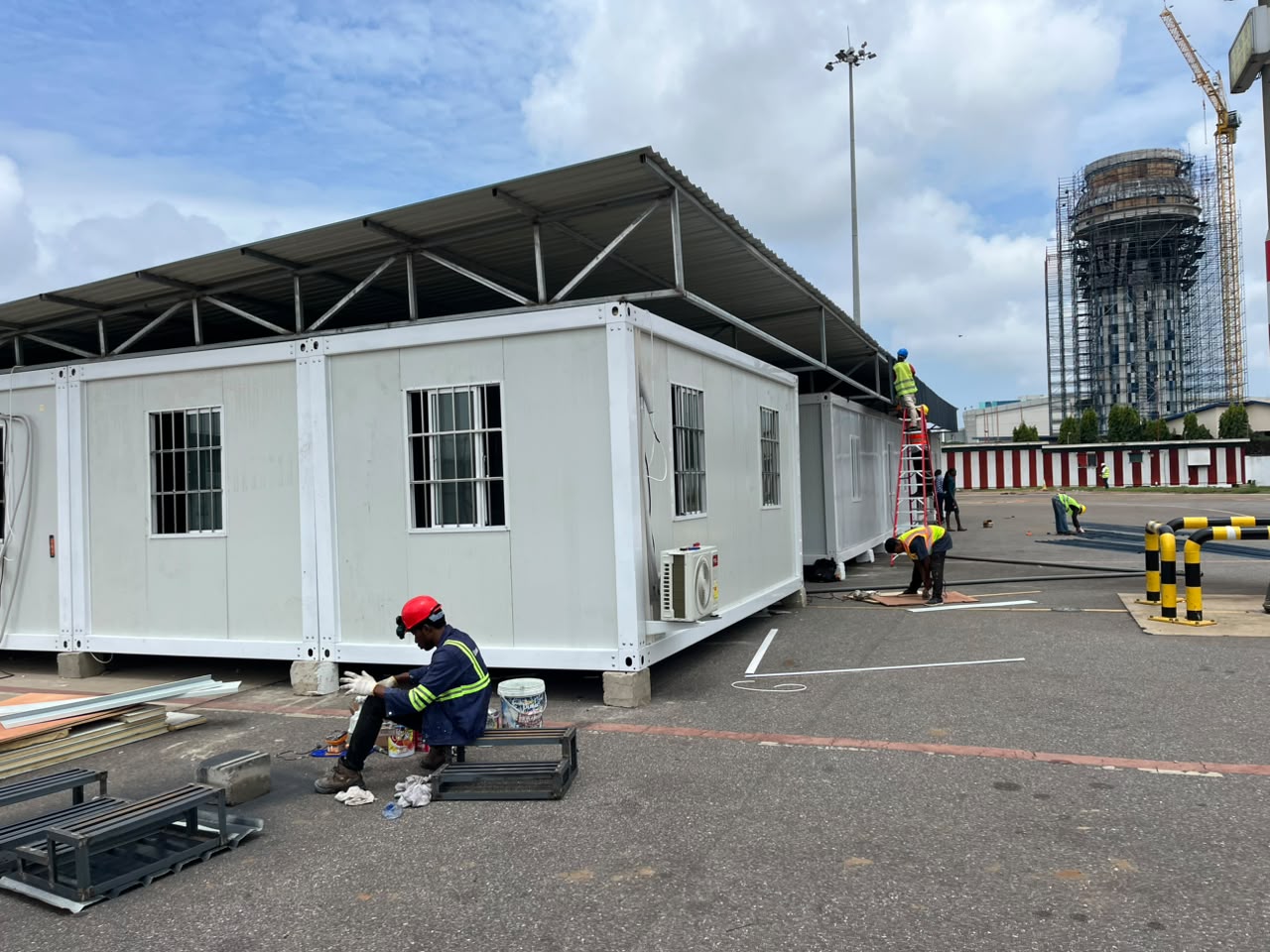
In prefabricated construction, the frame, wall and roof panels, doors, windows and services are made and fitted off site, then delivered and assembled on prepared foundations. The evidence on what this changes:
- Speed. McKinsey found that modular construction can reduce construction time by up to 50 per cent, with off-site production running while foundations are laid and manufacture 20 to 50 per cent faster than traditional methods (Consultancy.uk, McKinsey analysis).
- Cost. The same analysis puts potential savings at up to 20 per cent, while noting that transport adds 2 to 10 per cent to total costs and that some projects can cost more (Consultancy.uk). Savings depend on scale, which is exactly what a national housing programme provides.
- Built to grow. With about 90 per cent of Ghanaian homes already built incrementally from savings (Al Jazeera), modular homes suit the way families already build: start with one module, and add the next as savings allow, finished at every stage.
- Cooler homes. A reflective roof coating now marketed in Ghana is reported to lower indoor temperatures by 2 to 5 degrees Celsius and cut cooling energy use by 11 to 27 per cent (Al Jazeera).
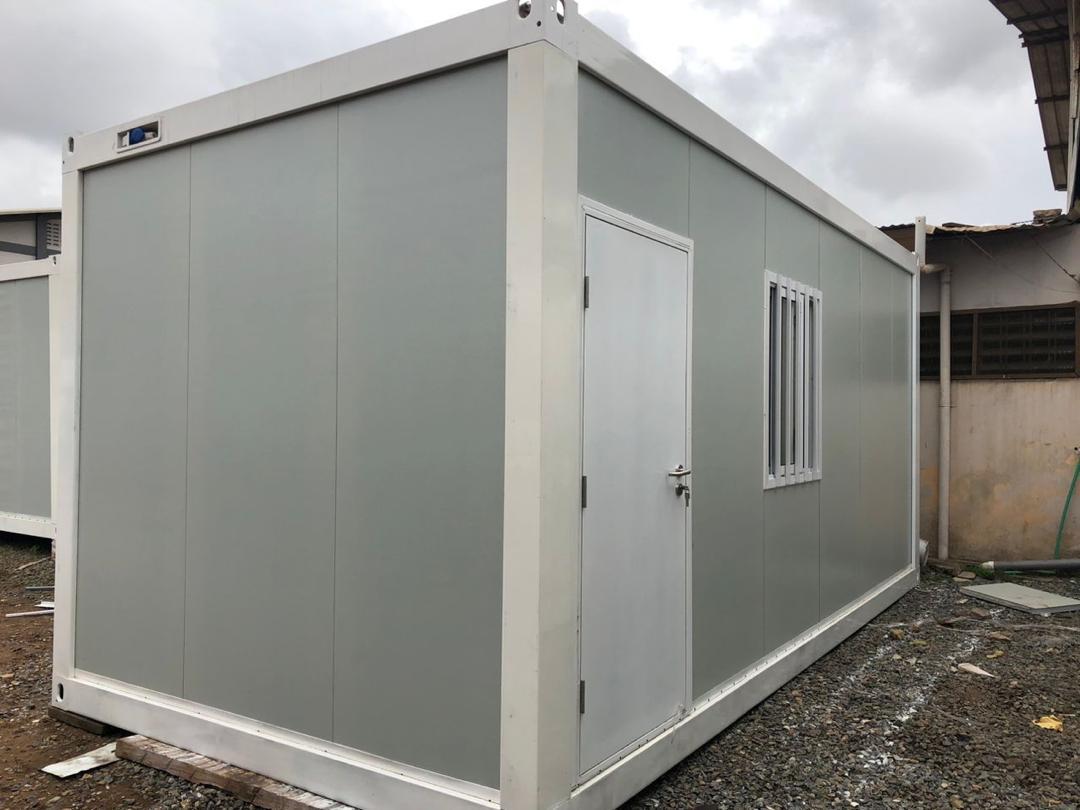
GIWU's own prefab work includes the supply and installation of prefabricated container offices with a steel roof canopy at Accra International Airport for ARG1 Africa (GIWU projects), and prefab units for clients including Berkon Group, Kross Project and Golden Cement Ghana (GIWU Prefab Systems). The same systems that house project teams can house families.
Upgrading without displacement: build first, move once
The Ghana Urban Forum's key recommendations on the new strategy state that slum upgrading should prioritise improvement in place rather than displacement (Commonwealth Local Government Forum, July 2026). Prefabrication makes that practical. We propose:
- Count and secure. Register every household with community leaders, and confirm each family's right to a new home, in line with the strategy's tenure regularisation measures.
- Build first. Use nearby public land, which the strategy already provides for, to put up the first multi-storey prefab blocks, with shops and workshops on the ground floor so livelihoods continue.
- Move once. Families move directly from their old structure into a finished home.
- Redevelop in phases. The freed land, through land pooling and readjustment, becomes the next phase of homes, roads, drains, water and community facilities.
- Pay as you live. Rent-to-own arrangements let families own their homes through monthly payments. One of the NHF's two real estate investment trusts has already piloted a rent-to-own scheme for people unable to access conventional mortgages (Ghana News Agency, May 2026).
What it will take
About 70 per cent of Ghanaians are in the low and middle-income bracket (Al Jazeera). Serving them will take every part of the sector. We propose:
- Government and assemblies: release serviced public land, fast-track permits for approved prefab house types, and review import costs on panels and steel used for certified affordable housing, given that about 70 per cent of housing inputs are imported.
- Banks and the NHF: extend mortgage and rent-to-own products to approved prefab homes.
- Developers and builders: design for low and middle-income households, not only the top of the market.
- Communities: take part in planning from the first day.
GIWU is ready to work with metropolitan and municipal assemblies, the National Homeownership Fund, development partners and community groups on a first pilot neighbourhood.
A home should not be a lifetime away
Affordable housing is only affordable when the people it is meant for can actually move in. When a two-bedroom home costs 135 years of minimum wage pay, and only 5 in every 100 Ghanaians can house themselves without help, the definition of "affordable" needs to change, and so does the way we build.
The policy is in place, the need is measured, and the technology is available. Let us make affordable housing affordable.
Share this article if you believe every working Ghanaian deserves a decent home, and tell us in the comments: what would make a home affordable for you?
Partner with GIWU on affordable housing
Assemblies, developers, financiers and community groups interested in a prefab housing pilot can reach our team directly.
Talk to GIWUSources
- Daily Graphic: President directs GH¢1bn into Housing Fund to tackle 1.8m deficit (October 2026)
- Ghana News Agency: Government moves to make decent housing affordable, inclusive for all (October 2026)
- Modern Ghana: State Housing opens Amrahia homes for sale (2026)
- Ghanaian Times: National daily minimum wage up to GH¢21.77 for 2026
- WageIndicator: Minimum wage, Ghana (monthly figure calculated on 27 days)
- Ghana News Agency: NHF to resume mortgage lending at 8.4 per cent (August 2026)
- Yen: Salary a Ghanaian may need to buy a house through the 8.4% mortgage scheme (2026)
- Yen: How much it costs to build a decent 2-bedroom house in Ghana in 2026
- GhanaWeb: Six-month rent advance rule (May 2026)
- Al Jazeera: Why more investment is not making housing affordable in Ghana (November 2026)
- MyJoyOnline: Average lending rate stood at 15.9% as of August 2026
- Ghana Statistical Service: Launch of the report on slums and informal settlements in Ghana, 2021 PHC (June 2025)
- Citi Newsroom: Ghana's 1.8m housing deficit demands urgent action (July 2026)
- Ghana News Agency: National urban and slum upgrading policies launched (July 2026)
- Commonwealth Local Government Forum: Ghana Urban Forum key recommendations (July 2026)
- Ghana News Agency: Ghana's housing future depends on innovative financing, NHF (May 2026)
- Consultancy.uk: McKinsey analysis, modular building could halve project time